
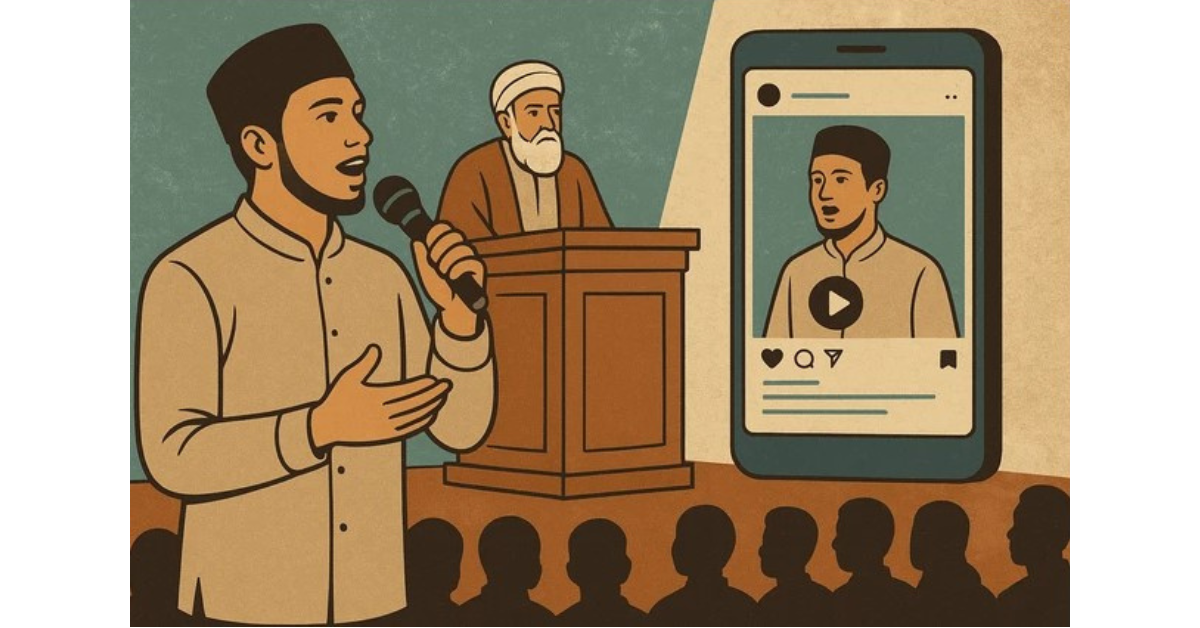
The Shifting Pulpit: When Preachers’ Popularity Undermines Scholarly Authority
There was a time when the pulpit was both a quiet and sacred space—a place where knowledge was delivered gently, through the soft voice of a kiai whose hair had begun to turn gray. Preaching flowed like water from a spring: clear, calm, and careful.
But now, that once-solid pulpit seems to be shifting. Something has changed—whether in the pulpit itself, the preachers, or us as listeners. The term “shifting pulpit” can be understood as a transformation in authority, space, and methods of preaching in today’s era.
This change has come gradually, carried by the digital age like an invisible wind. Suddenly, preaching no longer waits for congregations in mosques or study circles. It jumps onto phone screens, slips into daily routines, and appears on the For You Page between cat videos and viral fried noodle recipes. There, popularity often comes before almost everything else.
Over the past decade, the face of the preaching world has changed rapidly. In the past, the stage was mostly occupied by pesantren scholars with clear scholarly lineage. Today, a new wave of preachers has emerged from diverse backgrounds—from graduates of Middle Eastern institutions to content creators who began their careers on YouTube or TikTok.
When Charisma Surpasses Scholarship
In the digital world, a loud voice, theatrical gestures, or catchy punchlines are often more effective than long explanations of Qur’anic exegesis and Islamic jurisprudence. A preacher skilled in reading algorithms can outperform a scholar who has spent decades studying classical texts.
This is not because the latter lacks knowledge, but because this new world recognizes no lineage other than follower counts and view metrics. At this point, we witness something unusual: the pulpit no longer stands on scholarly authority, but on performance skills.
Preachers as Stars, Congregations as Audiences
Preaching has always been about communication, but rarely have we imagined preachers as entertainers. Yet today, the preaching stage often operates on the same logic: those who are funnier, more dramatic, or more emotional are more easily sought after, shared, and admired—regardless of their label or persona.
Fanbases form, complete with jargon, group identities, and unconditional loyalty. Here, preachers shift into public figures not unlike celebrities. And once someone becomes a celebrity, controversies inevitably follow. Meanwhile, traditional scholars—who speak cautiously, weigh their words with legal consideration, and avoid sensationalism—often appear “less appealing” to the rhythm of digital media.
From Pulpit to Screen, From Knowledge to Content
The phrase “From Pulpit to Screen, From Knowledge to Content” reflects the internet’s vast opportunities. Preaching can now reach millions without spatial limits. However, it also brings a trap: knowledge turns into content.
When knowledge becomes content, it is pressured to be short, attention-grabbing, shareable, and—most dangerously—superficial. Preachers who follow this pressure gradually adjust their messages to become more viral. As a result, depth of knowledge is often sacrificed for reach. The richness of Islamic scholarly tradition is compressed into one-minute clips. We all know that something compressed too tightly will eventually change its form.
A Society Seeking Quick Answers
Perhaps the popularity of preachers is not merely because they seek fame, but because we as audiences desire simplicity. We want quick solutions, direct guidance, and practical advice that makes life easier. In a fast-paced world, we seek religious answers the same way we search for cooking tutorials.
It is therefore natural that those who speak plainly, emotionally, and energetically are preferred over those who invite us to think slowly and deeply. In this sense, the “slipping pulpit” is not only about preachers, but also about ourselves.
Scholarly Authority Must Not Be Abandoned
Nevertheless, many young preachers possess solid knowledge and maintain integrity amid the digital tide. They navigate two worlds at once: the deep tradition of pesantren and the ever-changing world of algorithms. In their hands, hope still exists.
Whatever the form of preaching today, we must remember that religion is a long journey, not a flash of a camera. It requires patience, not merely popularity; precision, not merely eloquence.
A slipping pulpit does not mean it will fall. It only needs to be supported again—by humble preachers, by a critical public, and by the awareness that popularity can never replace the depth of knowledge.
Finding a Middle Ground
Not all popular preachers lack knowledge, and not all traditional scholars are technologically illiterate. Many young figures master religious knowledge while skillfully preaching on social media. The challenge is not choosing between “the popular” and “the scholarly,” but how to unite the two so that preaching remains relevant without losing depth.
Popularity is often seen as a measure of credibility, as many people judge preachers by follower counts rather than educational background or scholarly lineage. This new generation of preachers brings both great opportunities and serious challenges.
Popularity can indeed help preaching reach more people, but scholarly authority must remain the foundation. In the digital era, both must go hand in hand so that preaching is not only viral, but also meaningful and responsible.
Author: Muhammad Izzul Islam An Najmi (Lecturer, Faculty of Ushuluddin)
Image Source: AI
This article has been published on Kumparan.com under the title: "Pergeseran Mimbar: Ketika Popularitas Pendakwah Menafikkan Otoritas Keilmuan"
Pergeseran Mimbar: Ketika Popularitas Pendakwah Menafikkan Otoritas Keilmuan | kumparan.com