
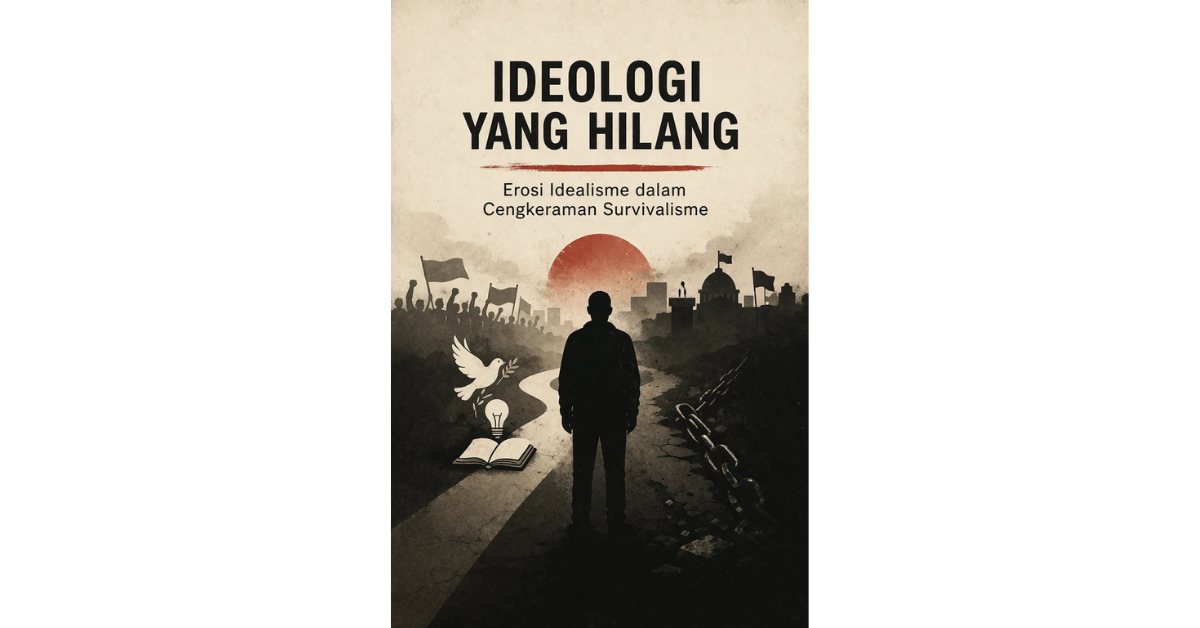
The Lost Ideology: The Erosion of Idealism under the Grip of Survivalism
On paper, Indonesia is a grand arena for ideological contestation. Political parties and civil society organizations are established with clear identities: nationalist, religious, populist, and even progressive. Yet in practice, there is an unwritten ideology that appears to transcend these boundaries and often proves more influential than any formal doctrine: survivalism.
In this context, survivalism does not refer to physical survival in the wilderness. Rather, it is a strategy for maintaining political, economic, and institutional existence amid constantly shifting power dynamics. It is not an ideology proclaimed in manifestos, but one that becomes visible through behavior and political practice.
When Ideology Becomes a Tool Rather than a Direction
Looking back, Indonesia was not always characterized by this condition. During the Old Order era, ideological competition was intense. Nationalism, communism, and religion openly confronted one another. Fierce debates—and even conflicts—emerged because each camp genuinely sought to advance a grand vision for the future of the nation.
With the arrival of the New Order, ideological space was simplified and tightly controlled. Nevertheless, even within those constraints, efforts were made to preserve value-based frameworks. Ideology remained an important reference point, although it could no longer be freely debated.
At the beginning of the Reformasi era, idealism regained momentum. Political liberalization created opportunities for diverse ideas to re-emerge. Political parties and civil society organizations competed to offer visions they believed would best promote the welfare of the nation and its people.
Over the last two decades, however, a noticeable shift has taken place. The ideological contestation that once served as the foundation of political struggle has gradually weakened. What has become increasingly important is the ability to adapt, build coalitions, and survive within the system. Ideology has not disappeared, but it has lost much of its binding force. The capacity to compromise and remain relevant has increasingly overshadowed commitment to ideological principles.
Survivalism and Group Interests
This ideological crisis is deeply concerning because it risks reducing political competition to a mere struggle for survival and self-preservation. During their formative years, many Indonesian political parties and civil society organizations were driven by strong idealism. They emerged from grand ideas: social justice, religiously inspired governance, inclusive nationalism, and civilized democracy.
Over time, however, idealism has often collided with the realities of power. Competitive political systems, high logistical costs, and pressures to remain relevant have compelled many organizations to adapt. It is at this point that survivalism begins to take over.
Rather than consistently maintaining ideological boundaries, many political actors choose flexibility. Coalitions that once seemed impossible become commonplace. Narratives that were once defended with unwavering conviction can change within a single political cycle. Principles become fluid, replaced by the need to survive.
At a deeper level, survivalism is not merely about survival itself; it is about determining whose survival matters. Here lies the central problem: preserving organizational existence often means prioritizing group interests over the public interest.
When political parties or organizations face a choice between upholding principles for the benefit of the public or preserving their own position and continuity, the latter often prevails. Power becomes a means of sustaining the organization rather than serving the people. This logic produces a subtle yet significant transformation—from “struggling for society” to “struggling to remain in existence.” In such circumstances, citizens are no longer the ultimate objective but become part of a broader political calculation.
Coalitions without Boundaries, Principles without Roots
The phenomenon of political coalitions in Indonesia offers one of the clearest illustrations of this trend. Parties rooted in nationalism and those based on religious platforms—which, in theory, should possess fundamental ideological differences—can easily stand together within the same governing coalition.
For some observers, this reflects political maturity. For others, it demonstrates that ideology no longer serves as the primary compass. What matters more is access to power, resources, and influence. Within the logic of survivalism, remaining inside the system is more important than maintaining principled distance from it. To be outside the system is to risk irrelevance—and in politics, irrelevance often means political death.
Ideological differences that were once considered fundamental lose their significance when confronted with the imperative of survival. Nationalism and religion, which should function as value-based foundations, increasingly serve as instruments of mobilization rather than ethical boundaries. In other words, actors who promote nationalism and those who promote religion frequently operate according to the same logic: pragmatic survivalism. Ideological distinctions become cosmetic, while political practices converge.
Is This Inevitable?
This raises an important question: Does idealism still have a place in contemporary politics? Is this condition inevitable?
The answer is far from simple. On one hand, political systems require compromise. No organization can remain entirely rigid without risking marginalization. On the other hand, without idealism, politics loses its moral direction. Survivalism may be necessary for endurance, but when it becomes the only guiding logic, it empties political struggle of its deeper meaning. Politics becomes a game of positioning rather than a vehicle for realizing collective visions.
Some may argue that this is an unavoidable feature of modern politics. No organization can survive without compromise, and survivalism is often viewed as a form of realism. Yet the real question is not whether survivalism is necessary, but rather the extent to which it dominates political life. When survival becomes the primary objective, the entire system begins to revolve around it, and idealism is reduced to a mere accessory.
At this point, survivalism emerges as the dominant logic. Political parties and civil society organizations no longer move solely to advance values but also to ensure their own institutional continuity. In many situations, the choices they make are not those most beneficial to the public but those safest for organizational survival. Consequently, group interests frequently take precedence over the common good.
The challenge for the future, therefore, is to restore balance. Survivalism may be unavoidable, but it must not eliminate idealism. Political parties and civil society organizations need to redefine their boundaries: when adaptation is necessary and when principles must be defended. Without such a balance, they risk losing their moral legitimacy. Ultimately, existence without purpose is merely empty continuity, and politics without idealism becomes nothing more than the management of interests rather than a struggle for a better future.
Author: Muhammad Izzul Islam An Najmi
Lecturer, Faculty of Ushuluddin, UIN Syarif Hidayatullah Jakarta
Image Source: AI
This article was originally published on Kumparan.com on April 19, 2026, under the title “Ideologi yang Hilang: Erosi Idealisme dalam Cengkeraman Survivalisme” https://kumparan.com/muhammad-izzul-islam-an-najmi/ideologi-yang-hilang-erosi-idealisme-dalam-cengkeraman-survivalisme-27D8o2V1GYJ