
Reflections on the 35th NU Congress: After the Election, Are We Still Brothers and Sisters?
Nahdlatul Ulama (NU) was not born out of an ambition to seize power. It emerged from the concerns, sense of responsibility, and sincerity of the ulama in safeguarding religion, the community, and the homeland. When K.H. Hasyim Asy’ari, together with K.H. Abdul Wahab Chasbullah and other pesantren scholars, founded NU on January 31, 1926, they were not establishing a vehicle for pursuing positions of power. Rather, NU was envisioned as a great home that would unite pesantren scholars in upholding the teachings of Ahlussunnah wal Jamaah while addressing social, economic, educational, national, and humanitarian issues.
K.H. Hasyim Asy’ari laid the organization’s moral and spiritual foundations. For him, leadership was a trust to safeguard religion and the welfare of the community, not an opportunity to advance personal interests. His careful consideration before approving NU’s establishment demonstrated that a major organization must not be built on momentary enthusiasm alone. It must rest on pure intentions, noble aspirations, and thoughtful consideration of the future of the community and the nation.
Alongside him, K.H. Abdul Wahab Chasbullah emerged as a driving force who worked sincerely without calculating personal gain. Long before NU was established, he had pioneered Nahdlatul Wathan in education, Tashwirul Afkar as a forum for intellectual exchange, and Nahdlatut Tujjar to build the community’s economic independence. From cities to remote rural areas, Kiai Wahab mobilized networks of ulama and pesantren. He devoted his energy not to glorifying his own name, but to strengthening the jam’iyyah.
This spirit was carried forward by K.H. Abdurrahman Wahid, widely known as Gus Dur. During his leadership of the NU Executive Board (PBNU), Gus Dur reaffirmed NU’s role as a jam’iyyah diniyyah ijtima’iyyah—a religious and social organization—and as a major force in civil society. He brought NU into conversations about democracy, humanity, pluralism, culture, and the defense of marginalized groups. Through his ideas and extensive networks, Gus Dur also introduced the international community to the moderate character of NU and Indonesian Islam.
Behind Gus Dur’s stature also stood a resilient woman, Nyai Hj. Sholihah Wahid. After the death of K.H. Wahid Hasyim, Nyai Sholihah did more than raise and educate her children. She remained actively involved in sustaining NU’s networks, worked through Muslimat NU, and initiated social programs, religious study circles, orphanages, maternity clinics, and welfare services for underprivileged communities. Her contributions demonstrate that NU’s great home was built not only by the kiai who appeared on the organization’s public stage, but also by nyai and women activists who served with sincerity, perseverance, and long-term dedication.
The legacies of these figures reveal a common thread: NU grew through khidmah—service and devotion—not through struggles for positions of power. They may have faced disagreements, competition, and even political pressure, but the interests of the jam’iyyah and the welfare of the community remained above personal and group interests.
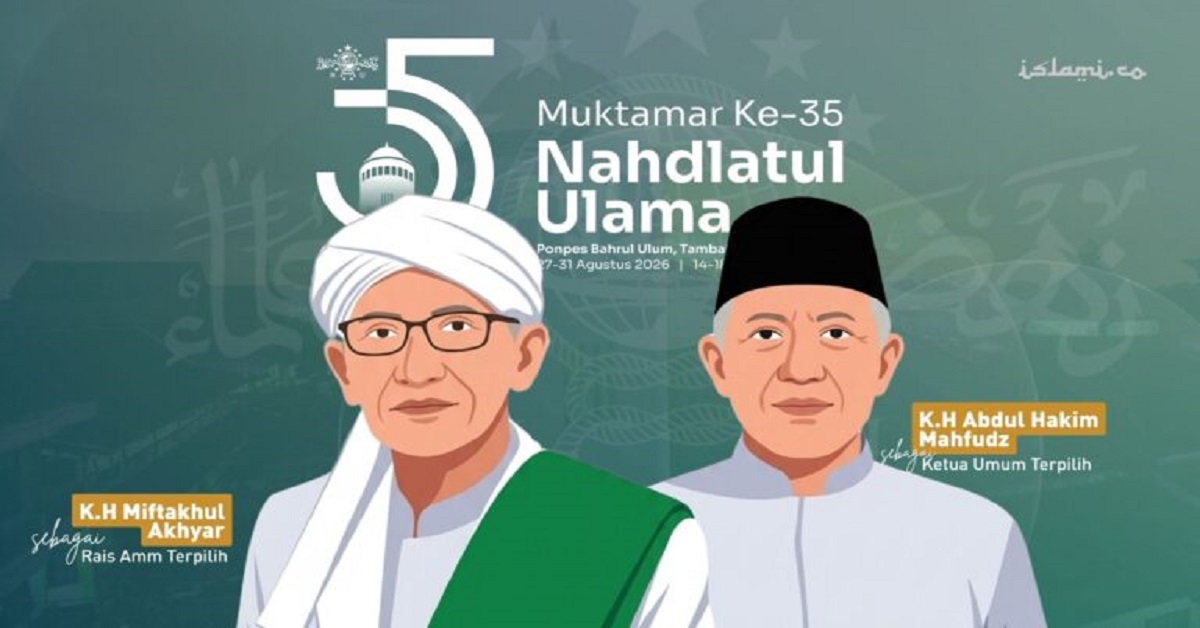
It is in this context that the 35th Congress of Nahdlatul Ulama must be understood. The Congress is not merely a forum for electing the Rais Aam and the General Chairperson of PBNU. It is the organization’s highest deliberative forum for determining NU’s future direction. Therefore, NU members should focus not only on who is elected, but also on how the election is conducted and how fraternity is maintained afterward.
Leadership elections almost always give rise to the mapping of competing forces. Some support one candidate, others support another, while some have yet to make a choice. Relationships are cultivated, support is gathered, strengths are assessed, and potential coalitions are considered. Within certain limits, all of this is a normal part of organizational dynamics.
Problems arise when differences in choice are no longer understood as part of deliberation but become a division between “friends” and “enemies.” Those who support the same candidate are regarded as friends, while those who choose differently begin to be suspected, avoided, or even treated as enemies. At this point, leadership contests risk leaving wounds that last far longer than the election itself.
The Congress and the Politics of Friends and Enemies
The 35th Congress of Nahdlatul Ulama, held on August 27–31, 2026, is not merely a forum for electing the Rais Aam and the General Chairperson of PBNU. It is the highest deliberative forum for determining NU’s future direction. Accordingly, NU members should pay attention not only to who is elected, but also to how the election is conducted and how fraternity is preserved afterward.
Leadership elections almost always lead to the mapping of competing forces. Some people support a particular candidate, others choose a different one, and some have not yet decided. Relationships are cultivated, support is gathered, strengths are assessed, and potential coalitions are considered. Within reasonable limits, these are natural elements of organizational dynamics.
Problems arise when differences in choice cease to be understood as part of deliberation and instead become a division between “friends” and “enemies.” Supporters of the same candidate are treated as friends, while those who choose differently become objects of suspicion, avoidance, or even hostility. At this point, a leadership contest may leave wounds that endure far longer than the election period itself.
The Logic of Friends and Enemies
Carl Schmitt, a German political thinker, argued that one of the fundamental patterns of political life is the distinction between friend and enemy. According to Schmitt, a political group constructs its identity by determining who belongs to “us” and who is placed among “them.”
This theory can help us understand the dynamics of leadership elections within organizations. As competition intensifies, people begin to classify one another: Who supports us? Who supports them? Who can still be approached, and who should be treated with caution? A classification that initially serves a strategic purpose can gradually become an all-encompassing judgment of a person.
However, Schmitt’s theory should not be accepted as justification for the idea that politics must always end in hostility. Rather, it can serve as a tool for recognizing the dangers involved. Not everyone who makes a different choice is an enemy. Nor is everyone who offers support necessarily a genuine friend. Friends and enemies in a contest are often temporary categories shaped by interests and circumstances.
Henri Tajfel and John Turner, through Social Identity Theory, explain that people tend to divide their social environment into in-groups and out-groups: our group and their group. Once this division takes shape, individuals tend to view their own group more favorably and perceive other groups more negatively.
During an election, a candidate’s name can become a group identity. Criticism of a candidate is perceived as an attack on all of that candidate’s supporters. Conversely, shortcomings in one’s preferred candidate tend to be forgiven, while the shortcomings of other candidates are magnified. As a result, objective assessments of leadership capacity, integrity, and vision may be overshadowed by group fanaticism.
This phenomenon is not limited to the election of PBNU’s General Chairperson. Similar patterns can be found in leadership elections within political parties, civil society organizations, universities, professional associations, and even religious institutions. Every contest has the potential to create factions. What must be prevented is the transformation of temporary factions into permanent hostility.
Different Choices Do Not Mean Different Jam’iyyahs
For NU, the logic of friends and enemies must never be allowed to overpower the principles of fraternity and khidmah. People may disagree over who would make the best leader, but they remain members of the same great home of the jam’iyyah. Differences in choice do not negate their shared commitment to upholding the teachings of Ahlussunnah wal Jamaah, safeguarding the community’s welfare, and serving the nation.
The Qur’an provides clear guidance:
وَلَا يَجْرِمَنَّكُمْ شَنَآنُ قَوْمٍ عَلَىٰ أَلَّا تَعْدِلُوا ۚ اعْدِلُوا هُوَ أَقْرَبُ لِلتَّقْوَىٰ ۖ وَاتَّقُوا اللَّهَ ۚ
“Do not let your hatred of a people lead you away from justice. Be just; that is closer to righteousness. And fear Allah.” (Qur’an, Al-Ma’idah 5:8)
This verse demonstrates that moral standards must not change according to whether someone is regarded as a friend or an opponent. Justice must be extended both to those we support and to those whose choices differ from ours. The strengths of our preferred candidate must not be promoted by spreading slander, false accusations, or unverified information about other candidates.
The Qur’an also reminds us: “The believers are but brothers, so make peace between your brothers” (Qur’an, Al-Hujurat 49:10).
The fraternity expressed in this verse does not mean eliminating differences. Rather, fraternity is tested when differences arise. It is easy to call someone a brother or sister when our interests align; the greater challenge is to continue treating that person as family when our choices diverge.
Therefore, the election of NU’s leaders should not end with the question, “Who will win?” A more important question is, “After the election, will all parties still be able to sit together and continue serving the community?”
Choosing Leaders Through the Ethics of Khidmah
At the 35th NU Congress, the mechanism for electing the General Chairperson became one of the issues under discussion: whether the election should be conducted directly by the Congress delegates or through a mechanism involving the Ahlul Halli wal Aqdi. Whatever mechanism is ultimately agreed upon, the quality of the election is determined not only by its procedures, but also by the ethics of the candidates, their supporters, the delegates, and the entire NU community.
Electing a leader is not merely a contest for a position; it is the entrusting of a responsibility. Therefore, the decision must be guided by the needs of the jam’iyyah: who is best able to uphold the dignity of the ulama, strengthen the organization, embrace differences, and respond to the challenges facing the community in NU’s second century.
Voters should also be alert to three tendencies.
First, personality-based fanaticism, which undermines objective judgment.
Second, the dissemination of information whose truth has not been established in order to weaken other candidates.
Third, the influence of interests from outside the organization that may compromise the independence of the delegates’ decisions.
Political networking need not be prohibited, but it must not turn into transactional politics. Support may be gathered, but not through coercion, inducements, or hate campaigns. Criticism may be voiced, but it should address vision, programs, track records, and capacity rather than attack personal dignity.
Candidates and their supporters should also establish a moral commitment that whoever is elected must be helped to carry out the entrusted responsibility. The winning side must not exclude everyone who supported a different candidate. Those who are not elected, meanwhile, should not continue to maintain a destructive opposition.
After the election, the categories of “my group” and “their group” must return to a single shared identity: members of NU.
Winning Without Humiliating Others: Safeguarding NU’s Dignity
The success of a congress is not measured solely by the election of a new leader. A congress can be considered successful when the election is conducted with dignity, the results are accepted graciously, and all organizational forces can return to working together.
Those elected must be able to win without humiliating others. Those who are not elected must be able to accept the outcome without losing their dignity. Supporters, too, must be able to end the competition once the forum has reached its decision.
After the Congress, no group should continue to claim that it alone truly owns NU, nor should any group be treated as an outsider in its own home.
In practical politics, the division between friends and enemies may be considered inevitable. In a religious organization, however, this logic must be restrained by moral character, justice, fraternity, and a commitment to the common good. A friend during an election is not necessarily always right, just as an opponent during an election is not necessarily always wrong.
K.H. Hasyim Asy’ari taught that an organization must be built on noble intentions and responsibility toward religion and the nation. K.H. Abdul Wahab Chasbullah demonstrated that NU’s greatness emerged from years of hard work, courage, creativity, and selfless service. Nyai Hj. Sholihah Wahid proved that caring for NU also takes place through family education, women’s movements, and services for underprivileged communities.
Meanwhile, Gus Dur helped NU become a force in civil society and introduced the international community to an Indonesian Islam characterized by openness, democracy, and respect for humanity.
May the 35th NU Congress not only produce a new leadership structure, but also revive the spirit of service embodied by its predecessors. NU needs leaders who are not merely capable of winning elections, but who can embrace all parties, safeguard the jam’iyyah’s independence, strengthen services to the community, and preserve public trust.
Amid national and global challenges, NU’s dignity must continue to be protected. NU is expected to remain a pillar of religious moderation, democracy, peace, social justice, and humanity, following the example set by its founders and prominent figures.
The leadership emerging from the 35th Congress should enable NU to become stronger at home and more respected internationally.
Ultimately, the Congress will pass and the leadership will change. What must endure is the jam’iyyah, fraternity, and the aspiration to serve. The victory of one candidate must never come at the cost of organizational division.
An election lasts only a few days, whereas ukhuwah (fraternity) and khidmah must be maintained for far longer. Therefore, the greatest challenge of the NU Congress is not merely to determine who is a friend and who is an enemy, but to transform all differences into a shared strength once the decision has been made.
For in NU’s great home, differences in electoral choices should temporarily separate the directions of support, not sever the bonds of fraternity forever.
An NU with Dignity, a Nation with Honor.
Author: Lilik Ummi Kaltsum, Lecturer at the Faculty of Ushuluddin.
Image Source: islami.co
This article was originally published on islami.co on August 30, 2026, under the title “Refleksi Muktamar NU ke-35: Setelah Pemilihan, Masihkah Kita Bersaudara?” (“Reflections on the 35th NU Congress: After the Election, Are We Still Brothers and Sisters?”).
Original article: https://islami.co/refleksi-muktamar-nu-ke-35-setelah-pemilihan-masihkah-kita-bersaudara/