
A Living Nature: An Islamic Philosophical Reflection on the Sumatra Disaster
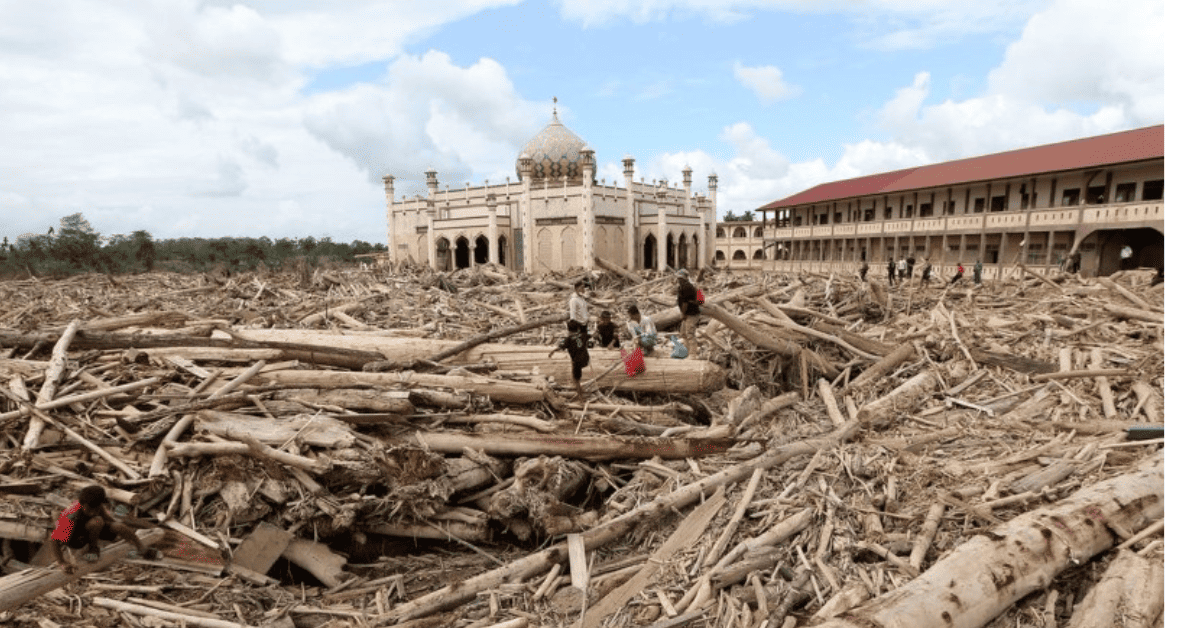
The dark clouds hovering over the highlands of Aceh, North Sumatra, and West Sumatra three weeks ago were not merely signs of the rainy season, but also expressions of nature’s long-suppressed sorrow and disappointment. The tears of the sky transformed into flash floods and landslides that swept away 147,236 houses, 1,600 public facilities, 145 roads and bridges, 219 health facilities, 967 educational facilities, 434 places of worship, and 290 buildings/offices, as well as claiming 1,059 lives (BNPB).
Mud, water, and tree trunks flowing rapidly from upstream to downstream paint a deeply personal portrait of nature’s suffering. This is not merely a hydrometeorological phenomenon, but a holistic erosion that reaches human reason and the souls of the greedy. When tropical rainforests that once maintained balance are replaced by fragile monoculture oil palm plantations, a living universe endowed with a soul does not remain silent. It groans, laments, and ultimately reclaims what has been taken from it in the most brutal way—through landslides and floods that struck 52 regencies/cities. Disaster is a complete warning expressed in the language of nature that we often ignore. After this great calamity, will we remain deaf? Or will we begin to listen to the whispers of this living nature?
Data on the rate of deforestation in Sumatra, as revealed by various national media, shows a stark reality. According to statistics from the Ministry of Forestry in 2025, total deforestation in Indonesia reached more than 175,437.7 hectares. The conversion of tropical rainforests into monoculture oil palm plantations has eroded the forest’s function as a water absorber, soil stabilizer, and guardian of biodiversity.
Although both are trees with leaves, tropical rainforest trees and oil palm trees differ greatly, especially in vegetation structure, root systems, and their impact on rainwater absorption. Tropical rainforest trees have dense and diverse vegetation cover. Large trees and thick leaf layers effectively filter water into the soil. Researchers in Panama have shown that forest trees possess complex root networks reaching depths of tens of meters.
In addition, these deep root systems store large amounts of carbon in the soil and firmly anchor it, preventing landslides. In contrast, monoculture oil palm plantations are dense but homogeneous, with relatively shallow root systems reaching only about one meter deep. Oil palm trees lack the complex root networks of forest trees, making them less effective in holding the soil during heavy rains. As a result, the land becomes more vulnerable to erosion and landslides.
Every hectare of tropical rainforest lost cuts millions of networks that hold the soil, store carbon, and protect interconnected ecosystems. Yet, our responses are often limited to narrow technical measures such as river normalization, safety embankments, or short-term replanting projects. This is where humanity’s greatest failure lies: failing to recognize the root causes of these disasters. We are busy treating the symptoms while ignoring the deeper paradigm that has shaped us into selfish and exploitative beings.
We view forests merely as collections of timber convertible into money, then transform them into oil palm plantations valued only by their contribution to regional economic output. Everything is measured by Gross Regional Domestic Product (GRDP). This is a form of blind ecological materialism that obscures our inner vision from understanding the true nature of a living universe. Muslim philosophers such as Ibn Sina and Ikhwan al-Safa referred to this as the nafs kulliyah (universal soul), which gives life and consciousness to the cosmos.
This universal soul flows through all existence, giving life, order, and purpose to every part of nature. Thus, Muslim philosophers describe the universe as a macro-organism interconnected by a single soul. Ecological destruction is a wound inflicted upon this living body. Floods and landslides in Sumatra are therefore natural responses of an organism suffering acute illness. Nature is trying to resist the disease of exploitation imposed by humans. When our own bodies are injured, we respond in pain—so too does nature.
This Islamic philosophical reflection teaches us that when we destroy forests, we are not only disrupting spatial order, but also wounding the universal soul and severing one of the lifelines of existence. Disaster is the cry of nature that can no longer be contained. It is a final warning that neglecting the soul of nature will ultimately strike back at human civilization.
May the floods and landslides in Sumatra awaken our deepest conscience, reminding us that nature deserves respect and wise treatment as a fellow creation endowed with a soul from God. Nature is our companion, our kin, our family in this life. Both humanity and nature are manifestations of the Divine, meant to sustain and balance one another.
Author: Ayu Lestari (Lecturer, Faculty of Ushuluddin)
Image Source: Kompas
This article has been published on Retizen Republika under the title:
"Alam Berjiwa: Refleksi Filsafat Islam atas Bencana Sumatra"
retizen.republika.co.id/posts/734280/alam-berjiwa-refleksi-filsafat-islam-atas-bencana-sumatra